Thiruvananthapuram is splits into Tiru + Anantha+ Puram” meaning “the town of Lord Anantha. The town is said to be the capital city of Travancore rulers and the kings have called themselves “Padmanabha-Dasa” (servants of Lord Vishnu), and ruled the state as the representatives of Lord Anantha-Padmanabha.
Sree Anantha Padmanabha Swamy Temple Hindu temple, and situated in Thiruvananthapuram. The temple is ancient and Garbhagriha (main sanctum) is carved out of a single stone.The temple is also known to be the Mahakshetraas it belongs to one of the 108 Divya desam (Divya Desams are shrines that have been sung by the Azhwars in their Pasurams, which are a part of the Divya Prabandham) in India.
It’s said that the temple was made on the first day of Kaliyuga 5000 year back. The temple is spread over 7 acres of land and has 4 main entrances.
Temple Timings
Morning: 03:30 am to 04:15 am, 05:15am to 06:15am, 08:30am to 11:00am, 12:00pm to 12:15pm
Evening: 05.00 pm to 06.30 pm, 07:00pm to 07:20pm
Dress code
Only Hindus are allowed inside the temple and the dress code have to be strictly followed, For Men its dhoti with bare chest and for woman its only sari or pavada (ling skirt) is allowed. Any bifurcates or any other kind of outfit is strictly prohibited. The outfits are available outside temple on rent.
12 Interesting facts about the temple

The idol Composition
The Lord Vishnu is in Anathashayanam position (sleeping position) which shows the trinity (Brahma, Vishnu and Shiva) made of kadasharakara (a composition of herbs, resin and sand).
The main idol is made with 12,500 saligram stones transported from the Gandaki river in Nepal. Saligramas are auspicious stones worshipped and venerated as the direct manifestation of Lord Vishnu.
The temple was first made of wood and later constructed with granite that its today. It has 365 pillars representing one for each day of the year.
Three doors for Darshan
The most unique feature of the Padmanabha Swamy temple is that it has the idols in reclining, sitting and standing postures.
The main idol is inside the sanctum sanctorum is in the reclining posture is 18 foot long, can be viewed through three doors –
first doors show the Lord’s face and Siva Linga underneath his hand
second door shows Brahma seated on lotus emanating from the Lord’s navel along with the “Utsava moorthi” and the idol viewed through the central door in the standing posture Lord MahaVishnu, Lakshmi devi (goddess of wealth) and Bhoomi devi (goddess of earth)
and the Lord’s feet in the third door. Utsava Murthi”, the idol taken out for the festival processions is in the sitting posture.
Ottakkal mandapam
Only the King of Travancore performs Namaskaram, or bow prostrate on this “Ottakkal Mandapam”. Since the idol of the Lord is also on this “Ottakkal Mandapam”, anybody who bows prostrate, or any material object that is kept here, henceforth belongs to the Lord.
Tradition says the King is a “Padmanabha Dasa”, (a servant of Vishnu). It’s also believed that lord Vishnu rules the Kingdom of Travancore
The Ottakkal Mandapam (single stone platform) is in front of the sanctum sanctorum of Lord Vishnu which is built with a single slab of granite. Its granite pillars are covered with gold.
Usage of gold in the Temple
The idol of Lord Sree Padmanabha Swamy is covered almost entirely in gold by a “Thanka Anki” or golden dress. The Ottakkal (or single stone) Mandapam in front of the main Sreekovil is covered in gold. The flag mast of Sree Padmanabha Swamy
is also covered in gold. Further, the Nivedyam called Navaratna payasam for the Peruthiru amrith pooja is offered to the lord in Gold Vessels.
A unique feature that came to light recently, while cleaning the idol is the fact that Lord Padmanabha’s idol is entirely cast in gold except for the face and chest. Along with the crown, ear rings, chiseled poonool, ornaments covering the chest, Lord’s legs and the right hand sporting a huge kankanam, the left hand holding a lotus and the lotus stalk are in gold. The kadasharakara (covering the idol with a dark coloured ayurvedic paste) was used to hide it from the Muslim invaders
The mysterious Vaults
The temple has 6 vaults known as kallaras labelled from A-F and as per supreme cout directions the chamber A were opened and On 2 July 2011, The chambers contain gold jewellery, medallions, precious stones, gold coins, model necklaces, stone-studded ornaments, golden armlets, head sets, heaps of pearl jewels, diamonds, golden lotuses, silver biscuits, decoration items for the Garudavahana, pooja items and festival equipment now it might become the richest temple in the world. The most amount of treasure was discovered in chamber A. Vault B is the final vault that has not been opened yet. The royal family there was a mystical curse associated with it.
Sreebalippura
Sreebalippura is a rectangular corridor built of stone is believed to have included 10,000 labourers and over 100 elephants for six months to construct it. Sreebalippura is supported by 365 and a one quarter of pillars. Each pillar is a monolith.
The gold Kodi maram
The flagpole or kodimaram is 80ft tall which was initially made with teak wood, later converted to golden flagpole has Garuda Swami, the sacred bird who carries Lord Vishnu, is carved on the top of the pole.
Intricate Gopuram
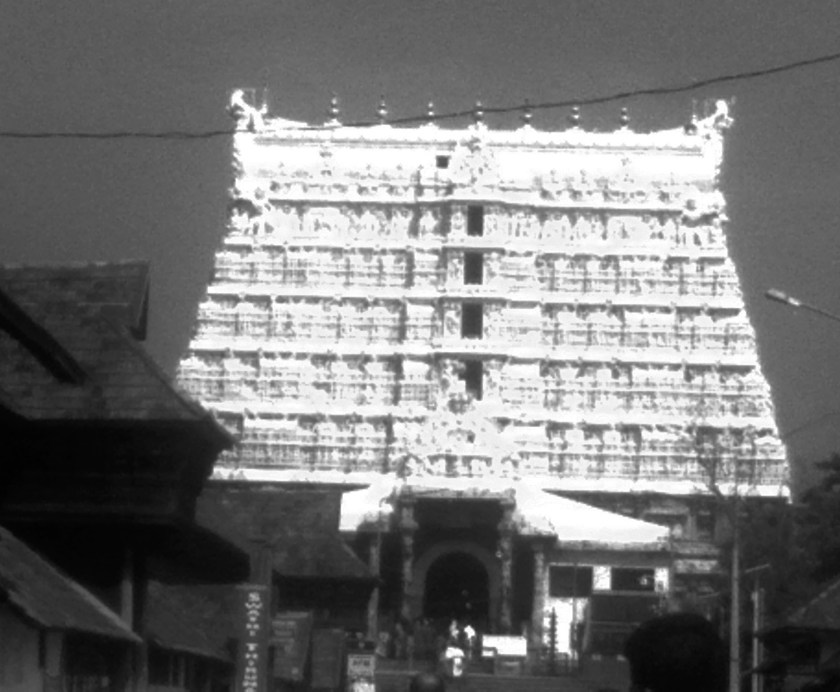
The 35-metre high seven-storey Gopuram made of granite imprints a visual remembrance of the temple in each spectator’s mind. The 10 incarnations of Lord Vishnu are depictedon the gopuram along with seven golden domes on the top. The opening on the ground floor has a grand doorway to enter the temple.
Archietectural marvel
The temple architecture is a fusion of Dravidian and Kerala style architecture. It is also known for its architectural marvel being creative achievements of the past in the fields of art, architecture, science, and engineering which cannot be compared to the present standards
The temple is said to have inspired by the Adi Kesava Perumal temple in Thiruvattar in Tamil Nadu. The deity of in both the temples are in reclining position.
Another marvellous architectural work is the Sapthaswara Mandapam supported by 28 balustrades of pillars its believed that the pillars on the four corners can produce musical notes when tapped.
The sacred Padmatheertham
Padmatheertham is one of the oldest water bodies in the city of Thiruvananthapuram and is the temple pond of the temple. This pond has been mentioned in several Hindu scriptures. Srimad Bhagavatha says that Balarama visited this Temple, bathed in Padmatheertham and made several offerings.
Beautiful Mural Paintings
The outer walls of the main sanctum are decorated with murals. The 18 feet long mural of the Ananthasayanam on the backside of the sanctum is termed as the largest one among the temple murals of Kerala, and was painted by Chalayil Kalahasti.
Thiruvambadi Sree Krishnaswamy Temple
Even though the Thiruvambadi Sree Krishna Swamy Temple is inside the main Temple walls, it enjoys the status of a separate Temple with separate flag-staff, sacred stones and its own rites and rituals. It is quite unusual. Here the presence of Sri Krishna in the form of Parthasarathi, is naturally luring. The outer walls of the temple are fully covered with lamps which is called Villaku Madom. Another significant and striking feature is the attractive Gaja Lakshmi carved on the top in granite.
Harrytinkers tips
- The dress code has to be strictly followed otherwise the entry is prohibited.
- You have to enter the temple barefoot
- Only Hindus are allowed inside the temple
- Gadgets are strictly prohibited
- No photography
- Try spending an hour inside the temple in order to explore all the above-mentioned interesting portions of the temple
- The sound of waves can be heard from the pillars inside the temple.
- The main sanctum is dimly lit and the idol is also dark in colour so you have to look closely to see the details of the idol
- Visit in the early hours to get a peaceful darshan
One of the best Hindu temples in terms of Architecture, history, grandeur and spirituality
Harrytinkers

 Harrytinkers travelog